

How to 10x Your Case Study Distribution (And Actually Drive Pipeline)
A GTM Engineer Experiment on exactly how to set up your case study distribution engine for maximum value


At Verbatim, we’ve shipped thousands of case studies for B2B companies - from seed-stage startups to post-Series C orgs scaling out their full customer marketing functions.
Here’s what most people don’t talk about: production is only half the equation.
The teams that actually see tangible results from case studies do two things well: great production and great distribution. If you nail both, ROI is almost guaranteed. If you skip the second half, you’re leaving pipeline on the table.
Today I’m going to walk you through what I call the Big 4 channels - the core distribution vectors that every B2B team should be running, and exactly how to ramp each one effectively.
Channel 1: On-Site Distribution
Phase One — Get It Live
The most common failure mode I see: case studies sitting in Google Docs. Teams haven’t done the original interview, don’t have strong first-person testimonials, don’t have a clear owner, and the asset never ships. Just getting a case study live on your site is a meaningful win, even if it’s just parked in your resources section next to your SEO/GEO resources hub.
That’s the simple first step. Now let’s go further.
Phase Two — Build a Dedicated Customer Collections Page
The moment you have two or more case studies, you need a dedicated home for them. Build a Customer Collections Page - ideally linked directly in your nav bar, labeled something simple like “Customers.” A few principles for doing this well:
Don’t reinvent the wheel on design. I see a lot of teams try to get overly creative here. That’s usually a mistake. It slows everything down and often produces something worse than the obvious execution. Instead, find two or three Customer Collections Pages from companies you like (Series C+ tends to have strong versions of this) and share them with your designer.
Shoot them a note on Slack along the lines of: “Here’s a direction for v1 - can you recreate this in our branding and color palette, then we’ll make adjustments from there?”
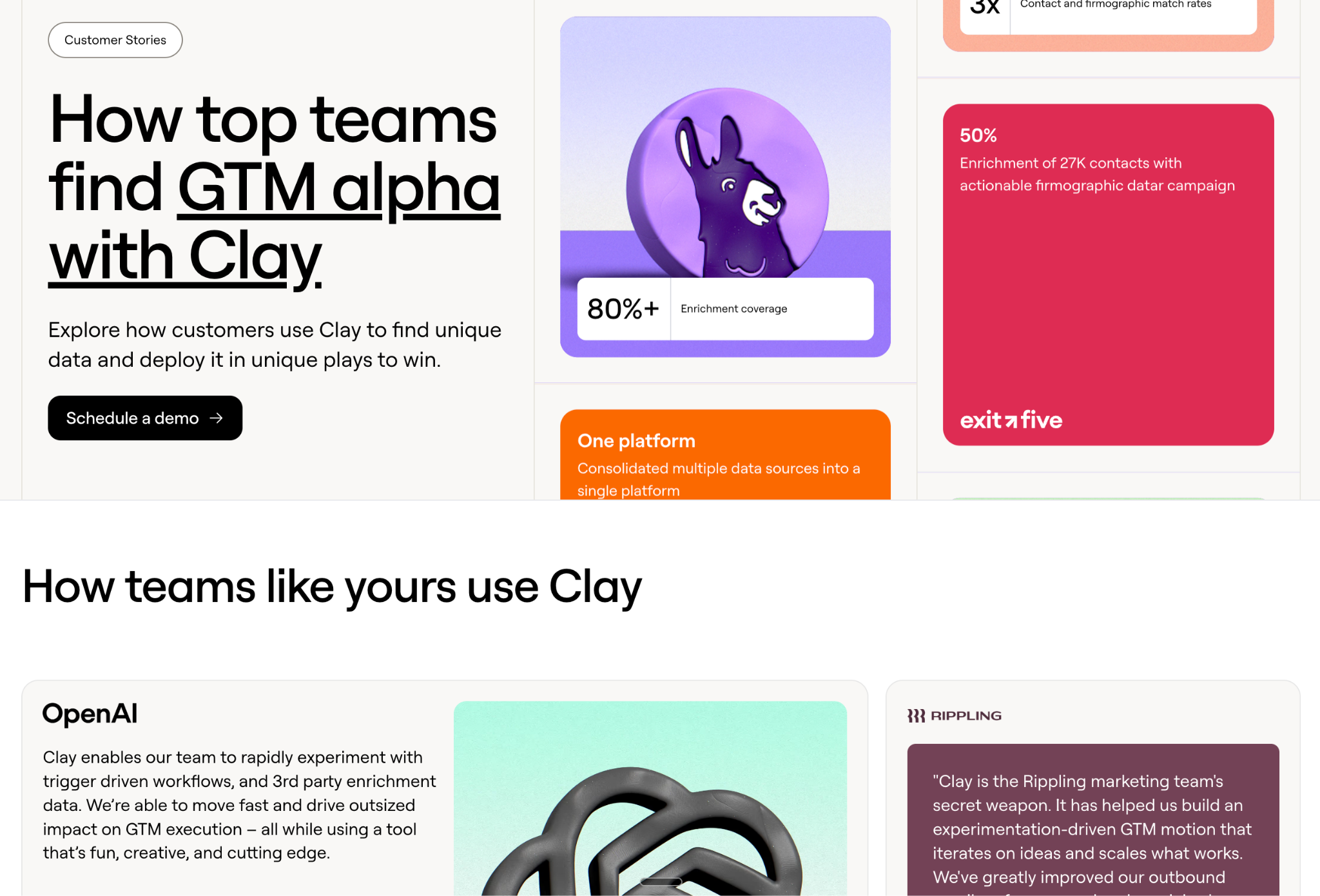
Standard grid layouts work well with layered testimonials throughout. Some companies add filtering by industry, use case, or segment. That’s a nice-to-have once you have volume. Strong examples here are Clay, WorkOS, Vanta, OpenAI, Replit, and Adaptive Security.
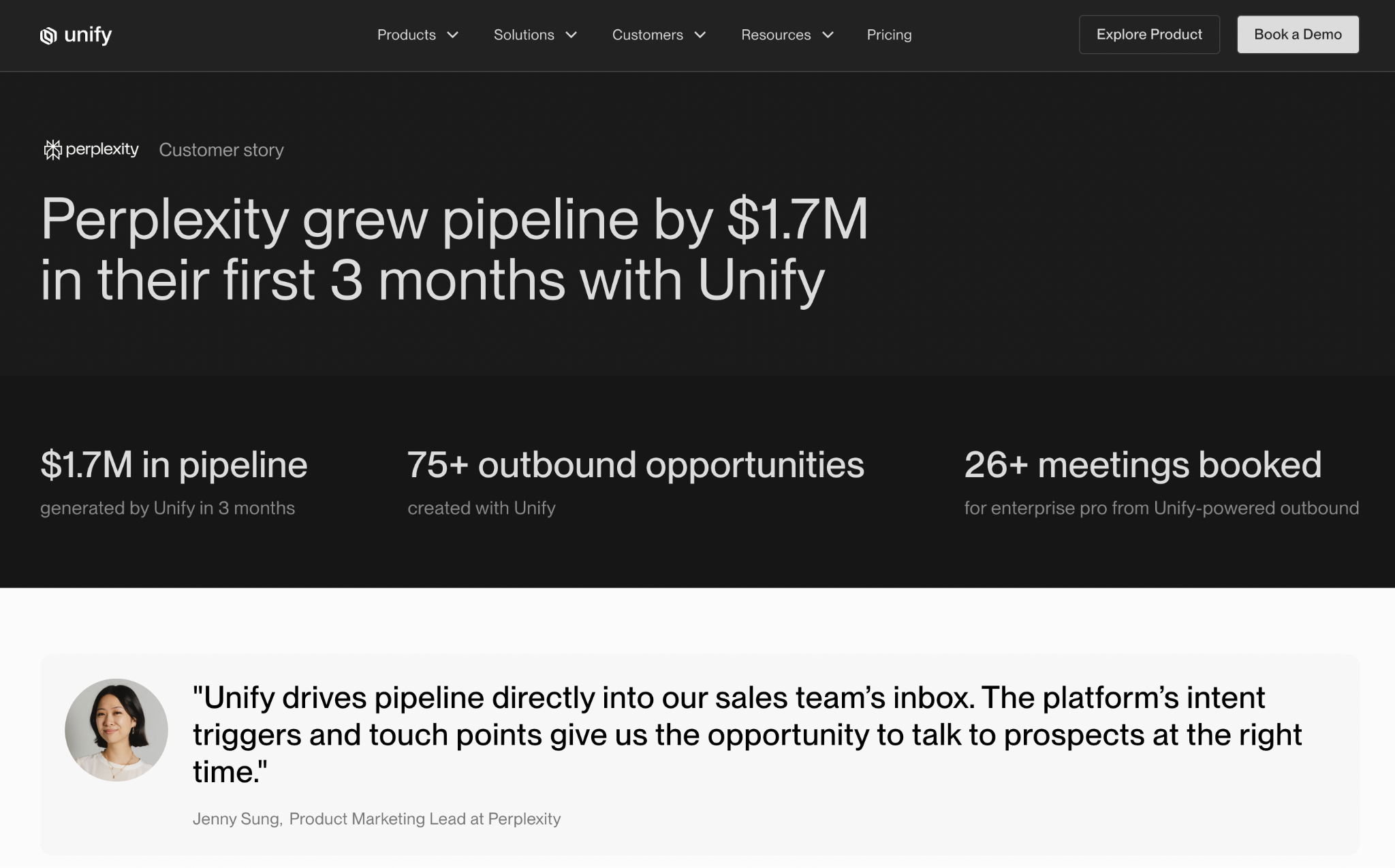
Build a custom case study template. Your case study page should look fundamentally different from your standard blog post - especially above the fold. The above-the-fold section is the most important real estate on the page. Most visitors will only see it. If it looks premium (great quote, clear metric, catchy title, strong logo) they’ll keep reading. If it looks like a blog post, they won’t.
Same principle applies: find case study template pages you like from other companies, share them with your designer, get a v1 that matches your branding, and iterate from there. Some strong case study templates that I like: Ramp, Linear, Unify, Perplexity, Ambrook, and Profound.
The good news: you only need to build these pages once. Do it well, and you won’t need to revisit them for two to three years. One investment, endless returns.
Phase Three — Cross-Link Across Your Site
Once your case studies are live in the right templates and your collections page is built, the next level is cross-linking social proof everywhere. And I really mean everywhere.
My overarching philosophy: overwhelm your prospects with social proof to build credibility, and trust that your product actually delivers what you say it delivers. In practice, this means:
Homepage: Logo brag bars, pull quotes, case study links - standard, but important.
Product pages: As you ship more case studies, they’ll start to cover more use cases. If you have three core product use cases and dedicated pages for each, pull the case studies most relevant to each use case and surface that social proof on those pages.
Solutions pages by ICP: If you’re segmenting by company size (SMB, mid-market, enterprise) or industry vertical, cross-link case studies that match each segment’s profile (e.g. how Fin does it). An enterprise prospect on your enterprise solutions page should see enterprise social proof (quotes, metrics, etc) from corresponding case studies with hyperlinks.
Paid landing pages: Any campaign-specific landing page (LDP) should include the most relevant testimonials and metrics from your case study library.
As your library grows, this cross-linking becomes exponentially more valuable. Every new page you build on your site is an opportunity to layer in fresh, targeted social proof.
Channel 2: Social Distribution (LinkedIn)
I’m going to focus specifically on LinkedIn here because that’s where 99% of the B2B teams we work with are active. This channel is primarily mid-funnel and bottom-funnel. If you want top-of-funnel LinkedIn strategy, that’s a different conversation. Case study distribution on LinkedIn is about deepening trust with prospects and channel partners already in your ecosystem or audience.
Phase One — Founder Posts the Case Study
Whoever is most active on LinkedIn (usually a co-founder or CEO) should post a distilled version of every case study when it goes live. A few format options that work well:
Narrative deep-dive on one specific use case from the case study
Problem → Solution → Results recap, kept tight and distilled for brevity
Quote-forward post that puts the customer in the spotlight (hero’s journey framing)
Quantitative post that leads with the metrics and builds from there (clear ROI & results)
Key mechanics of the post formats:
Build a custom graphic or pull a short-form video clip from the interview.
Post the body copy and asset, then drop the case study link in the first comment - not in the post body itself. It will hurt distribution.
Share the post link with your broader team immediately and ask them to like, comment, and ideally repost with a short line. Quote reposts perform very well.
For marquee logos you’re especially excited about, reach out directly to your cap table, close partners, or friendly network and ask for engagement - especially reposts with a sentence or two of commentary.
Phase Two — Get Your Full Team Posting
The second level is making sure everyone external-facing is using case studies as LinkedIn collateral, not just the founder.
Your sales team, head of demand gen, BDRs, partnerships lead - anyone who’s building their presence and talking to prospects should have a reason to post when a new case study drops. It’s a low-lift, high-relevance opportunity. The content already exists. All they have to do is write a quick intro and pull a visual.
For external-facing folks who know they should be posting on LinkedIn but never get around to it - case studies are the path of least resistance. Five minutes of effort, built-in credibility, trust-based collateral targeting to their network.
Phase Three — Repurpose Aggressively
Here’s a content truth that’s easy to forget: nobody remembers what they saw on LinkedIn an hour ago. They definitely don’t remember yesterday or last week. I absolutely don’t.
A single strong case study contains enough material for four to five posts over weeks or months. Lead with metrics one week, flip to a narrative angle two weeks later, pull a different quote a month after that. Vary the visual. Vary the copy angle. The story is still great - just tell a different dimension of it each time. Ultimately, it’s all about staying top of mind. In my experience repurposing social proof on LinkedIn, the second, third, and fourth post impression counts will stay relatively consistent as long as the copy and visuals continue to be strong.
One note: when you’re repurposing, dial back the “boost ask” to your network. You don’t want to constantly hit people up for engagement. But your internal team should still be sharing and posting on their own timelines.
Channel 3: Sales, BD, and Demand Gen
This is the most underrated channel and, honestly, the simplest to execute.
There are three things you need to get right:
1. Ensure the team knows the asset exists.
The number of times I’ve seen a case study go live and the sales team not know about it for two weeks is pretty wild. When a new case study goes live, marketing should immediately notify sales, BDRs, growth, BD - anyone client-facing. The message is simple: “New case study is live. Here’s the link. Here’s what it covers. Use it.”
2. Ensure it’s embedded in enablement materials.
Sales deck, pitch deck, one-pagers, proposal templates - wherever your team is presenting or sending collateral, case studies should be embedded and up to date. This is usually marketing’s responsibility to maintain. Outdated case studies in a deck can be as bad as no case studies.
3. Ensure the team is actually using it.
Knowing something exists and actually using it in every relevant conversation are two different things. Best practice here is to match case studies to the prospect - by segment (SMB vs. enterprise), by use case, by industry.
If you’re talking to a mid-market head of engineering and you have a case study that matches that profile exactly, that case study should be in the conversation. In practice:
During the discovery call: Drop the case study link in the chat while you’re talking. “We just shipped this. Very similar use case.” It contextualizes what you do in real terms.
In follow-ups: If you’re having trouble booking the next call, a new (or different) case study is a great re-engagement thread.
All the way to close: Social proof compounds. Keep layering it in at every stage.
Channel 4: Email (Inbound & Outbound)
I’m going to focus on four core email campaign types - two outbound, two inbound.
Outbound 1: Cold Outbound
If you’re running cold outbound sequences, case study content should be woven throughout. That means using strong metrics as proof points, pulling specific testimonials that are relevant to the ICP you’re targeting, and linking to full case studies where appropriate.
Most B2B buyers have seen this pattern (a strong quote, a clean metric, a link) because it works. It’s not flashy, but it consistently outperforms outbound that just describes what you do.
Outbound 2: Warm Outbound
When you’re running signal-based outbound (funding triggers, hiring signals, tech stack changes, etc) or targeted ABM campaigns, relevance is everything. Pull the case study that most closely matches the target account’s segment, industry, or use case - and make that the credibility anchor for your outreach. Don’t use generic proof. Use bespoke ICP-matched proof.
Inbound 1: Nurture Flow
A lot of early-stage teams don’t have a mature nurture sequence because they don’t have enough content assets to fill one. Here’s how we do it at Verbatim: anyone who submits their email on our site gets added to a plain-text, bi-weekly case study drip. One case study every two weeks. We use Loops for this, though HubSpot, Attio or any CRM marketing platform works fine.
It doesn’t have to be fancy. Plain text emails outperform designed emails in a lot of B2B nurture contexts anyway. The goal is to keep warm leads in your ecosystem and consistently remind them that your product delivers results for people like them.
As your content library grows, blend case studies in with product marketing content, thought leadership, and announcements. The cadence (weekly vs. bi-weekly vs. monthly) should reflect your sales cycle - faster cycles warrant faster nurture.
Inbound 2: Newsletter
Most teams have a monthly newsletter, and most of them aren’t using it well for social proof. In every newsletter you send, regardless of the other content in it, include one or two case studies. Format: a link, the key metric, and a standout quote. Don’t bury them at the bottom. Treat them as a real section of the newsletter.
Your newsletter goes out to your full ecosystem: investors, operators, partners, channel partners, former prospects, customers, friends of the company, etc. All of them benefit from being reminded of the ROI your product drives. It builds credibility across the board, not just with active pipeline.
Putting It Together: The Execution Framework
Reading through all of this, you might notice: none of it is particularly complicated. That’s the point. Case studies are a canonical example of simple, not easy.
The gap between teams that drive ROI from case studies and teams that don’t isn’t knowledge - it’s really just execution. Here’s what you need to actually run this well:
Clear DRI for each channel. Who owns on-site? Who owns LinkedIn? Who briefs the sales team? If it’s everyone’s job, it’s no one’s job.
A launch checklist. Every time a case study ships, the same 10 to 15 distribution steps run in order. Build the checklist once. Use it every time.
A cadence for repurposing. Don’t just post once and move on. Schedule repurposed LinkedIn content for 2 weeks, 1 month, and 3 months after the initial launch.
Regular sync between marketing and sales. Quarterly at minimum - review what’s in the library, what’s getting used, what’s not, and where there are gaps.
Ongoing iteration. Track which case studies are performing best in which contexts. Double down on what’s working and cut what’s not performing.
Case studies are one of the highest-leverage content investments a startup can make. But the leverage only shows up when you distribute them properly. Nail the production workflow, then execute the distribution phase, and the ROI takes care of itself.