


if you build outbound for a living, you probably believe something most brand marketers don’t.
you believe a single email doesn’t matter. you send ten thousand of them and expect almost all of them to get ignored. you don’t rewrite the sequence because tuesday was quiet. you look at replies once a week, pull the few that landed, figure out what they had in common, and put that into the next batch. nobody on your team has ever held a meeting about email #4,812.
the best organic creator program i know of runs on the same logic. it sends videos to feeds instead of emails to inboxes, and otherwise i’d struggle to tell you the difference.
i know because we built it. my team built and ran the creator engine for tabs chocolate, which gets more than 100 million organic views a month across tiktok, instagram and youtube.
so i’m going to take the engine apart, explain why i think a gtm engineer would recognize every piece of it, and then argue with myself for a while.
what’s actually in the engine?
six parts. honestly none of them is very interesting alone.
one number. organic views a month, across every account. we look at it weekly, because the daily number jumps around too much to be useful. paid spend lives in a different program so it can’t mess up the read.
a roster. lots of creators posting about one brand, instead of one big influencer. the case study calls it a wall of creators.
dedicated accounts. each creator posts to an account that only exists for tabs. @naomixtabs, @bealovestabs, @tabs.monica, @marinalovestabs. everything on those accounts is about tabs, so anyone who follows one is following tabs.
every day, three platforms. every account posts daily on tiktok, instagram and youtube. the same video can do great on one and nothing on another, and you can’t predict which.
a weekly review. look at what broke out, write one sentence on why, and turn the best of those into prompts for everybody.
one team running it. someone checks every account every morning. someone recruits. someone handles contracts and usage rights. someone runs the review.
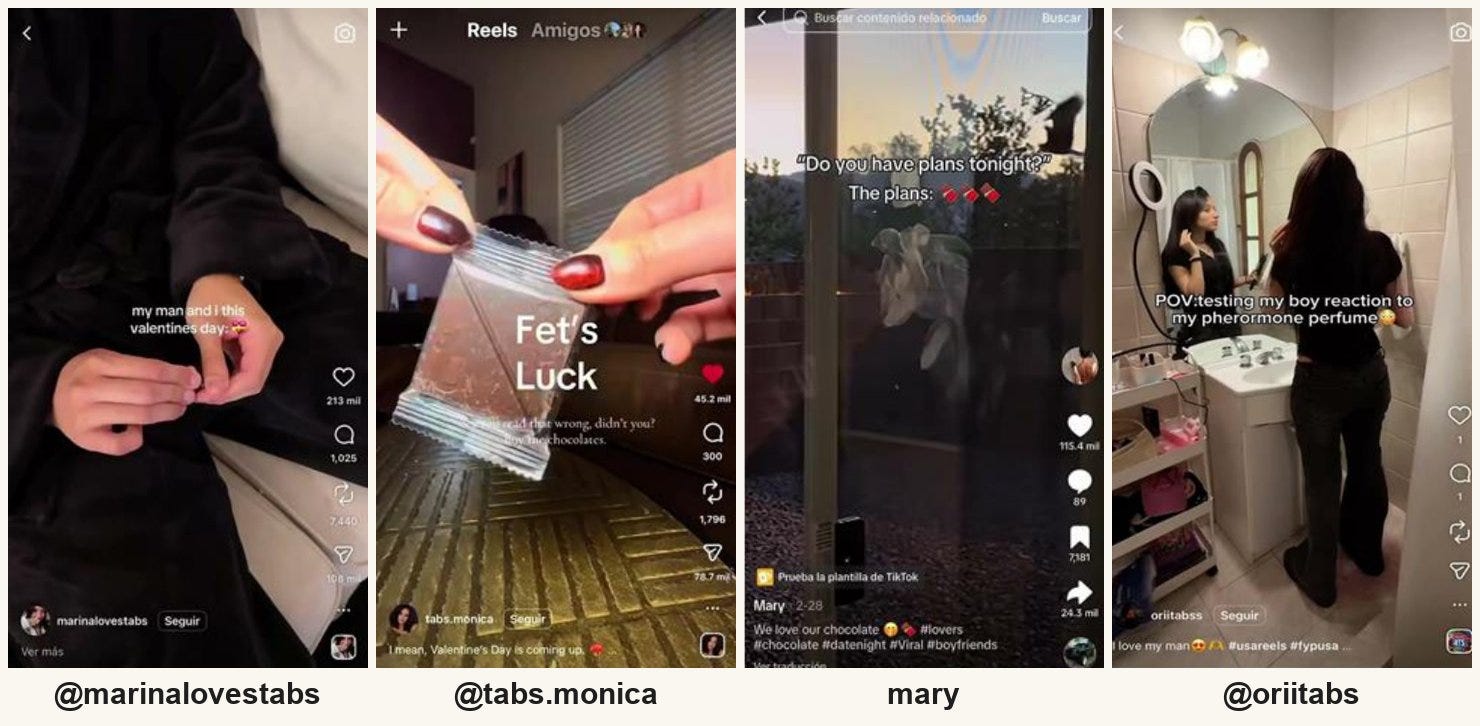
four of the dedicated accounts. each one exists to post about one chocolate bar.
read that list back with outbound in your head and it’s a target metric, a pool of senders, warmed domains, daily send volume, reply analysis and an ops person. i didn’t plan it that way. it just ended up there.
what does it look like day to day?
mostly like nothing is happening.
the typical post gets a few hundred views. scroll any of the accounts and you’ll see 398 views, 313, 245, 201, 190, 187, 121. on the posts we screenshot for the case study, the like counts go 8, 10, 15, 20, 29, 35.

a normal week. a box held up on a lawn got 8 likes. “trying the viral chocolate with my gf” got 10. this is most of the program.
some of these are good videos. “adding special chocolate to my husband’s banana split to see how fast it works” is a great premise and it got 175 likes. “pranking my dad with tabs chocolate” got 996. that’s just how feeds work.
and then every so often one goes. 22.9k likes. 66.3k. 136.8k. 464.9k.

same kind of people, same kind of phone, same product.
the big ones are really big. one reel did 17.7 million views and 347,000 engagements. one video did 8 million views at 11% engagement. another reel did 6.5 million. on @bealovestabs the top two posts did 266.2k and 42.4k views, and pretty much everything around them is under 400. [2]
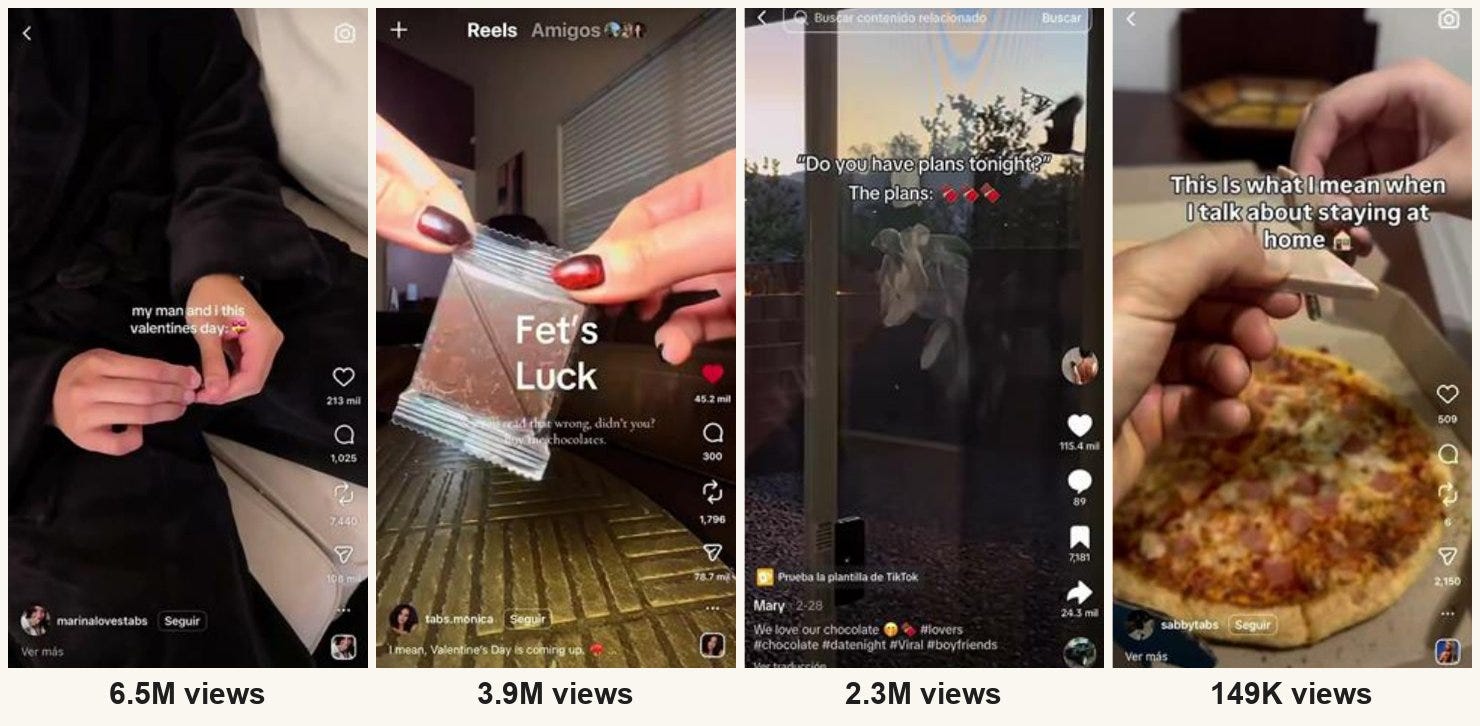
reels from the program: 6.5m, 3.9m, 2.3m and 149k views.
@naomixtabs has 316 videos and 910.9k likes. most of those videos are ones nobody would ever screenshot. the account works anyway.
think of it as reply rate. the average post is a bounce. the breakout is a booked meeting. if you judge the program on the average post you’ll shut it down, and you’ll be wrong.
why call it a gtm system?
because it has the same parts as one. there’s an input you control, an output you can count, somewhere for people to convert, and a review that makes the next round better.
a single post works a lot like a cold send. the feed shows it to a few hundred strangers and watches what they do. if they watch to the end, it gets pushed to more people. if they scroll past, it dies. the people who follow or tap through are your replies, and an account that slowly picks up followers is basically a warmed list.
posts per day is the input. the number that break out is your hit rate. the profile link, and people googling tabs after a good video, is the conversion. the weekly review is the loop.
i think most brands don’t treat it this way because there’s a person on screen holding a chocolate bar, and that reads as marketing, not infrastructure. but if you strip the faces out, the plumbing is the same.

the wall.
here’s the simplest version of the argument i can make.
two companies want to reach the same thousand strangers.
company one pays one famous creator for one big post. it’s a good post. maybe it works. either way, next week that creator is posting for someone else and company one starts over.
company two hires a handful of regular people who like making videos. each of them posts once a day to an account that’s only about company two. most of the posts miss. by week three they’ve taken around a hundred swings between them, company one has taken one, and company two has a pretty good idea which openings make people stop scrolling.
company one bought an ad. company two built a channel.
nobody in gtm would run company one’s play for pipeline. one perfect email to one perfect prospect and hope. but that’s still how a lot of brands buy creators.
what’s the math?
this is an illustration, not tabs’ real roster size.
30 accounts posting once a day is about 900 posts a month. if most get a few hundred views and a few break into the millions, the few do almost all of the work. a few hundred posts at a few hundred views each barely registers next to a single 17.7 million view reel.
the part people miss is what happens when you cut volume. halve the posts and the views mostly don’t drop by half. what drops by half is how many lottery tickets you’re holding, and the winning tickets are where nearly all the views come from.
it’s the same reason you wouldn’t cut send volume after a slow week. slow weeks are normal.
before launching anything i’d do one multiplication: accounts × posts per day × 30. if you get less than a few hundred posts a month, you’re probably not taking enough shots to find a breakout.
where’s the engineering?
in the weekly review. volume gets you a lot of attempts. the review is why attempt #800 is better than attempt #8.
every week the team pulls the posts that clearly beat their account’s normal numbers. we don’t try to copy the post. we try to say, in one sentence, what people reacted to. sometimes it’s a format, sometimes a hook, sometimes a situation or a feeling. the best of those sentences become two or three prompts that go to the whole roster.

trying-it-for-the-first-time videos from the roster.
say a post breaks out because the creator filmed a friend trying the chocolate for the first time. the takeaway is “first reactions.” the next prompt is: film someone trying it for the first time, however you want. ten creators come back with ten different first reactions, a couple of those break out, and you do it again.
it’s a/b testing with a ton of variants and a person in the middle. after a few weeks the whole roster’s average goes up, because everyone is learning from everyone else’s hits and not only their own. a prompt that hasn’t produced a breakout in two weeks gets dropped, the same way you’d kill a subject line that stopped getting opens.
if you’ve ever built a sequence that rewrites its own copy based on which variants got replies, you’ve built this. the creative is a 20 second video and the copywriter has a phone.
and who runs it?
this is the part brands underestimate.
a roster posting every day on three platforms is an operations job. someone has to find and vet creators, write the one page roster card with the brand basics and the dos and don’ts, sort out contracts and usage rights, check every account every morning for missed posts, and run the review at the same time every week.
most brands hand this to a marketer on top of their actual job. then it falls apart in the usual order: a few missed posts, then a missed week, then nobody’s posting. it’s the same thing that happens to a sequence nobody’s watching. the domains burn, the list goes stale, and two months later someone says outbound doesn’t work for them.
tabs had one team on it every day. at dependables, stephanie mendez runs the creators. she finds them, briefs them and keeps them posting. in gtm terms she’s the ops seat, and the program doesn’t run without her.
ok. the case against.
i reread this and it sounded too pleased with itself, so here are the problems.
tabs is a viral brand to begin with. it’s one of the most viral consumer brands online, and some of the 100 million is just the product. a b2b dev tool with the same roster and the same posting schedule won’t get these numbers. i can’t tell you how much is the engine and how much is the chocolate.
it looks broken for a long time. in a first month you might see 60 posts a week, nearly all under a thousand views, and one that clears 200k. on a daily chart that looks random. a lot of teams kill it there. some of them are right to, because some products just don’t work on a feed.
creators quit. a sending domain doesn’t get sick or bored or take a better offer. people do. you have to replace quiet creators fast because the roster only works when it’s full, and each new person starts from zero on that account.
i’m biased. you’re reading about the program that worked, written by the person who built it, who also sells this as a service.
where i actually land: an organic creator program is a top of funnel gtm motion with the same shape as outbound. lots of cheap attempts, mostly misses, a few big hits, and a weekly loop that makes the next batch better. if you run it like a sponsorship you’ll get some nice videos. if you run it like a system you get a channel you own. it won’t work for every product, and it takes longer to look like it’s working than anyone is comfortable with.

so what would i do?
if i were a gtm engineer and someone handed me a creator budget tomorrow:
pick one number, organic views a month across every account, and look at it with the team once a week
hire for consistency, not follower count. the only question is whether this person can post every day for a month
give each creator a dedicated brand account and a one page roster card
post every day on tiktok, instagram and youtube, natively, and film in batches so one sick day doesn’t break the streak
flag anything that beats its account’s normal numbers within 48 hours, and turn the best into next week’s prompts
then leave it alone for a full month. you wouldn’t judge an outbound campaign on 40 sends, so don’t judge this on 40 posts.
